
Honda Fit tire size
Original tire sizes for the Honda Fit, model years 2007 through 2020. Trim levels and wheel packages change the size within the same year, so confirm on the door-jamb sticker before ordering.
Check before you order. The surest answer is the tires on the car right now: the size is molded into the sidewall. The placard inside the driver's door tells you what the factory fitted, which can differ from what a previous owner put on. Our guide on reading a tire size shows exactly where to look.
Buy tires for your Honda Fit
2015-2020, LX/EX
Same size all four corners
2015-2020, EX-L
Same size all four corners
2009-2013, Sport optional
Same size all four corners
2007-2008
Same size all four corners
Each button opens our pick in that size at SimpleTire, at the price shown: the mid-range tire where the shop stocks it, otherwise our budget or premium pick, and only when none of those is listed the cheapest tire in stock. The size page has budget and premium picks too. Prices exclude mounting. Check the sticker inside the driver’s door before you order.
Size by year and trim
| Model years | Trim or package | Tire size | From, per tire | |
|---|---|---|---|---|
| 2015-2020 | LX/EX | 185/60R15 | $50 | Prices |
| 2015-2020 | EX-L | 185/55R16 | $60 | Prices |
| 2009-2013 | Sport | 185/55R16 | $60 | Prices |
| 2009-2013 | Sport optional | 205/45R17 | $62 | Prices |
| 2007-2008 | Standard | 175/65R14 | $45 | Prices |
Tire size by model year
| Model year | Tire size | Trim or package | From, per tire | |
|---|---|---|---|---|
| 2020 Honda Fit | 185/60R15, 185/55R16 | LX/EX or EX-L | $50 | Prices |
| 2019 Honda Fit | 185/60R15, 185/55R16 | LX/EX or EX-L | $50 | Prices |
| 2018 Honda Fit | 185/60R15, 185/55R16 | LX/EX or EX-L | $50 | Prices |
| 2017 Honda Fit | 185/60R15, 185/55R16 | LX/EX or EX-L | $50 | Prices |
| 2016 Honda Fit | 185/60R15, 185/55R16 | LX/EX or EX-L | $50 | Prices |
| 2015 Honda Fit | 185/60R15, 185/55R16 | LX/EX or EX-L | $50 | Prices |
| 2013 Honda Fit | 185/55R16, 205/45R17 | Sport or Sport optional | $60 | Prices |
| 2012 Honda Fit | 185/55R16, 205/45R17 | Sport or Sport optional | $60 | Prices |
| 2011 Honda Fit | 185/55R16, 205/45R17 | Sport or Sport optional | $60 | Prices |
| 2010 Honda Fit | 185/55R16, 205/45R17 | Sport or Sport optional | $60 | Prices |
| 2009 Honda Fit | 185/55R16, 205/45R17 | Sport or Sport optional | $60 | Prices |
| 2008 Honda Fit | 175/65R14 | Standard | $45 | Prices |
| 2007 Honda Fit | 175/65R14 | Standard | $45 | Prices |
Which brand should you pick?
Honda does not stamp its own approval code on tires the way Porsche or BMW do. Any tire in the right size that meets or exceeds the load index and speed rating on your door placard is a legitimate replacement, so pick on wet braking, tread life and price. Our picks for each size are on the size pages below.

The drawing carries the sizes we list for this car, so you know what you are looking for. The placard on the car is still the final word, and it is the only place that gives the cold pressures: the number molded into the sidewall is the maximum the tire can hold, not what your car wants.
What those tires cost
About the Honda Fit
The Fit was Honda's subcompact hatchback in the US from the 2007 model year to 2020, sold as the Jazz nearly everywhere else. It is famous for holding more cargo than cars a class above it, and its tires are among the smallest and cheapest sold at any tire counter. Fitments run from 175/65R14 on the first US cars to 185/60R15 and 185/55R16 on later ones, with a 17-inch option on the 2009-2013 Sport.
Launched in 2006. Launched in the US in 2006 as a 2007 model, five years after the car went on sale in Japan, the Fit arrived with a fuel tank mounted under the front seats and a folding rear bench Honda marketed as the Magic Seat, which is what gave a car this small a genuinely large cargo hold.
How to tell the model years apart
Wheel and tire sizes follow the generation, not the badge, so identifying yours matters before you order.
2007-2008
First generation (GD), US model
Tall, narrow hatchback with a steeply raked windshield, a short hood and a very upright tail; only two model years were sold in the US. It runs 14-inch wheels on 175/65R14 tires, usually steel with covers. The dashboard has a simple round instrument cluster rather than the layered pod of the next car.
Tire sizes: 175/65R14
2009-2013
Second generation (GE)
Longer and lower, with a more wedge-shaped profile, a wraparound windshield and a two-tier dashboard. Base cars run 15-inch wheels on 185/65R15 while the Sport moves to 16s on 185/55R16, with a 205/45R17 available through Honda accessories. Paddle shifters appeared on the Sport's automatic.
2015-2020
Third generation (GK)
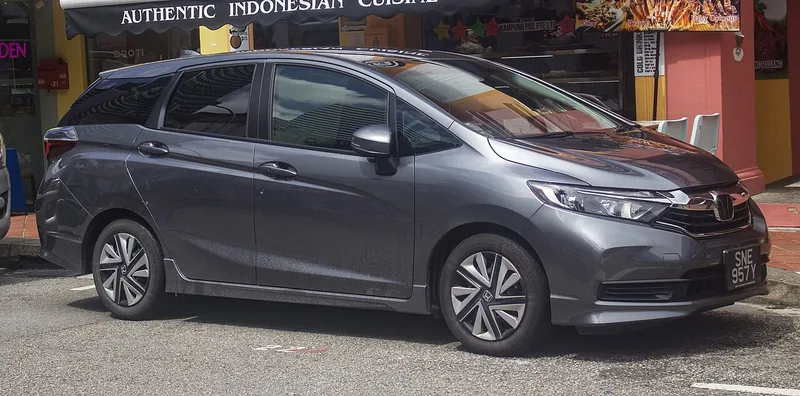
Shorter overall but with more rear legroom, a more aggressive nose and a hidden rear door handle in the C-pillar. LX and EX trims run 15-inch wheels on 185/60R15 and the EX-L takes 16s on 185/55R16. Honda skipped the 2014 model year in the US entirely while moving production to a new plant in Celaya, Mexico.
What the press said
Reviewers were consistently enthusiastic about the Fit's packaging, calling it the class benchmark for interior space and cargo flexibility, and they liked the way the first two generations drove, with quick steering and a willing engine. Fuel economy and Honda's reliability record drew regular praise. The criticism was road and engine noise, cheap-feeling interior plastics and a CVT on later cars that made the modest power feel more modest still. Most reviews of the 2015-2020 car concluded that it had become more practical and less fun than the 2009-2013 version, and that its main rival was really a used compact rather than another subcompact.
Still, the 2020 Fit is among the most practical and versatile small cars on the market.
Car and Driver, 2020
| Model year | Units sold in the US |
|---|---|
| 2010 | 54,354 |
| 2011 | 59,235 |
| 2012 | 49,346 |
| 2013 | 53,513 |
| 2014 | 59,340 |
| 2015 | 52,724 |
| 2016 | 56,630 |
| 2017 | 49,454 |
| 2018 | 35,300 |
| 2019 | 35,414 |
| 2020 | 32,488 |
| 2021 | 8,695 |
US sales peaked at 79,794 in 2008 when fuel prices spiked, settled around 50,000 to 60,000 a year through the mid-2010s and fell to 32,488 in 2020, the last full year before Honda withdrew the Fit from the US in favor of the HR-V.
Was it a success?
A modest commercial success in the US and a much bigger one abroad, where the Jazz has been a top seller for two decades. Resale is unusually strong for a subcompact because the packaging gives it a practical appeal nothing else in the class matches, so clean used examples are not cheap. Reliability is very good, with the main caveats being the CVT on 2015-2020 cars and rust on early examples in salted states.
Did you know?
- The Fit's fuel tank sits under the front seats rather than behind the rear ones, which is what allows the Magic Seat to fold completely flat and gives the car cargo space out of proportion to its size.
- Honda skipped the 2014 model year in the US entirely while it moved Fit production to a new factory in Celaya, Mexico, so no 2014 Fit exists for the American market.
- Everywhere outside North America and China the same car is called the Jazz, a name Honda avoided in the US.
Tire options on the Honda Fit
Fit tires are among the cheapest sold: 175/65R14 on the 2007-2008 cars, 185/65R15 or 185/55R16 on 2009-2013 models, and 185/60R15 or 185/55R16 on the final generation, with a 205/45R17 accessory fitment on the Sport. Nothing uses run-flats, nothing is staggered, and the load ratings needed are modest because the car weighs around 2,600 pounds, so standard-load passenger tires are all it asks for. Factory rubber was inexpensive all-seasons from Dunlop, Bridgestone or Firestone, and because the Fit is noisy to begin with, a quieter touring tire is one of the most noticeable upgrades available. Winter tires are cheap and widely stocked in all the Fit sizes, which makes a dedicated winter set an easy call on a light front-drive car that needs the traction. Owners sometimes upsize to the 17-inch fitment for looks, but on a car with this little sidewall to spare it costs ride comfort and makes pothole damage much more likely.
Sources: en.wikipedia.org, caranddriver.com.
Honda Fit tires: common questions
What size tires does a Honda Fit take?
The most common original size is 185/55R16. Other model years and trims use different sizes, so check the list on this page and confirm against the sticker inside your driver's door.
Can I fit a different size on my Honda Fit?
You can, within limits: the overall diameter should stay within about 3 percent of the original, and the load index and speed rating must meet or exceed the door placard. Anything further changes your speedometer reading and can rub at full lock.
Where is the tire size on a Honda Fit?
Open the driver's door and look at the white and yellow placard on the door jamb or the B-pillar. The same size is also molded into the sidewall of the tires currently on the car, unless someone changed them.
What size tires does a 2020 Honda Fit take?
The 2020 Honda Fit came from the factory on 185/60R15 and 185/55R16. Wheel packages can change that within the same model year, so check the placard inside the door jamb before you order.
What size tires does a 2019 Honda Fit take?
The 2019 Honda Fit came from the factory on 185/60R15 and 185/55R16. Wheel packages can change that within the same model year, so check the placard inside the door jamb before you order.
What size tires does a 2018 Honda Fit take?
The 2018 Honda Fit came from the factory on 185/60R15 and 185/55R16. Wheel packages can change that within the same model year, so check the placard inside the door jamb before you order.