
Mud-Terrain Tires
Aggressive off-road tires with big tread blocks for mud and rock; loud on pavement.
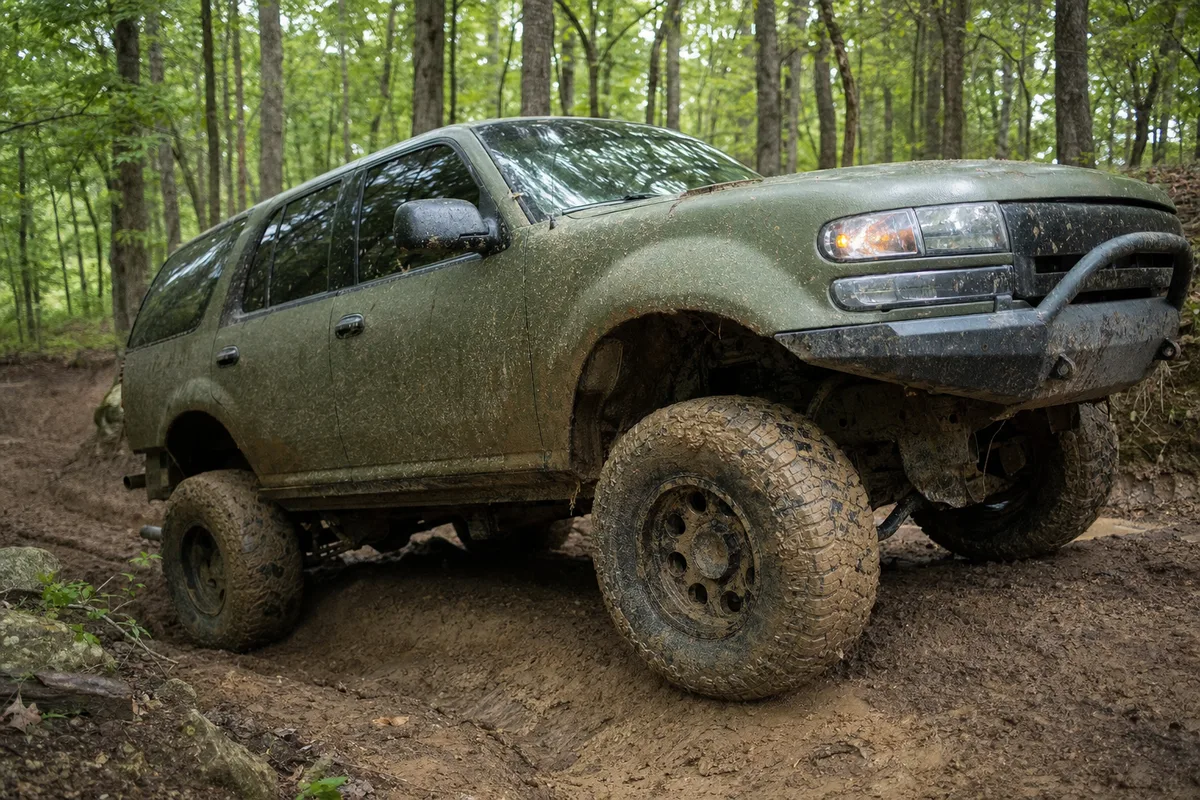
Mud-terrain tires are the most aggressive tires you can legally drive on the road. The tread has huge, widely spaced blocks that clear mud and grip rock ledges, the shoulders extend down the sidewall for traction in ruts, and the carcass is built with three-ply sidewalls to survive sharp rocks. On a trail, nothing else comes close. The BFGoodrich KM3, Toyo Open Country M/T and Nitto Trail Grappler are the established names; Falken, Cooper, General and budget brands like Milestar all offer credible alternatives.
They are for lifted trucks, Jeeps and off-road builds that spend real time in mud, sand or rocks. They are not for a truck that lives on the highway. On pavement a mud-terrain is loud, wears fast (25,000 to 40,000 miles is typical), rides rough, stops longer in the wet and costs two to three miles per gallon. Very few carry a mileage warranty. Most are also poor on packed snow and ice, since the big blocks have little siping; a few models carry the 3PMSF symbol but that is the exception.
When shopping, almost all mud-terrains come in LT sizes with load range C, D or E. Load range C is lighter and rides better on a Jeep; E is for heavy trucks and towing. Check the ply rating on the sidewall, the weight (some 35-inch tires exceed 70 pounds each) and whether the size fits your wheel width. Prices run from about 190 dollars for a budget 31-inch tire to 450 dollars or more for premium 37-inch sizes.
Buy this if
Off-road enthusiasts with lifted trucks or Jeeps that see mud, sand and rock regularly.
- Unmatched traction in deep mud, sand and on rock
- Three-ply sidewalls resist cuts and punctures
- Look the part on a lifted truck
Skip it if
Your truck is mostly a daily driver, or you need quiet, long tread life or good wet braking.
- Very loud on the highway and rough-riding
- Short tread life and no mileage warranty on most
- Poor on ice and wet pavement; costs 2 to 3 mpg
Best mud-terrain tires right now
Milestar Patagonia M/T
The best-known budget mud-terrain, with a loyal following among trail builders.
Ironman All Country M/T
A low-cost mud-terrain for a trail rig that rarely sees highway miles.
General Grabber X3
Race-proven Continental engineering with red-letter sidewalls at a fair price.
Cooper Discoverer STT Pro
A US-built mud-terrain that is more civilized on pavement than most.
BFGoodrich Mud-Terrain T/A KM3
The most trusted mud-terrain for rock crawling, with Michelin backing.
Toyo Open Country M/T
Legendary durability on lifted trucks, especially in large LT sizes.
Common sizes for mud-terrain tires
Mud-Terrain Tires: common questions
Are mud-terrain tires good in snow?
In deep, loose snow the big tread blocks work reasonably well. On packed snow and ice they are poor, because the blocks lack the fine siping that gives grip on hard surfaces. If you need winter ability, an all-terrain with the 3PMSF symbol is a much better choice.
How long do mud-terrain tires last?
Typically 25,000 to 40,000 miles on a truck that sees a mix of trail and pavement, less if the truck is heavy or lifted or the tires are underinflated. Almost none carry a mileage warranty. Rotating every 3,000 to 5,000 miles and keeping the alignment correct extends life considerably.
How loud are mud-terrain tires?
Loud enough that most owners notice a constant hum at highway speed and a drone that increases as the tread wears unevenly. Newer designs like the Toyo Open Country M/T and BFGoodrich KM3 are quieter than older tires, but none are quiet. If noise matters, a hybrid or all-terrain tire is the better compromise.
Load range C, D or E for a mud-terrain?
Match your truck's placard. Jeeps and half-ton trucks often do well on load range C or D, which is lighter and rides better. Three-quarter-ton and one-ton trucks and anything that tows heavy loads should stay with load range E. A heavier tire than you need costs ride quality, fuel economy and money.