
Speed Rating and Load Index: What the Letters Mean
The two characters after the size on a tire sidewall, for example the 91V in 205/55R16 91V, are the service description. The number is the load index: 91 means each tire can carry 1,356 lbs at its rated pressure. The letter is the speed rating: V means the tire was tested to sustain 149 mph. Replacement tires should match or exceed both figures on your door placard.
The load index is the safety-critical one and there is no flexibility: never go lower. The speed rating is more forgiving, since a T-rated winter tire on a V-rated sedan is legal and common as long as you drive within the tire's limit. Full tables below, then the LT rules, the up-or-down rules and what the rating says about ride.
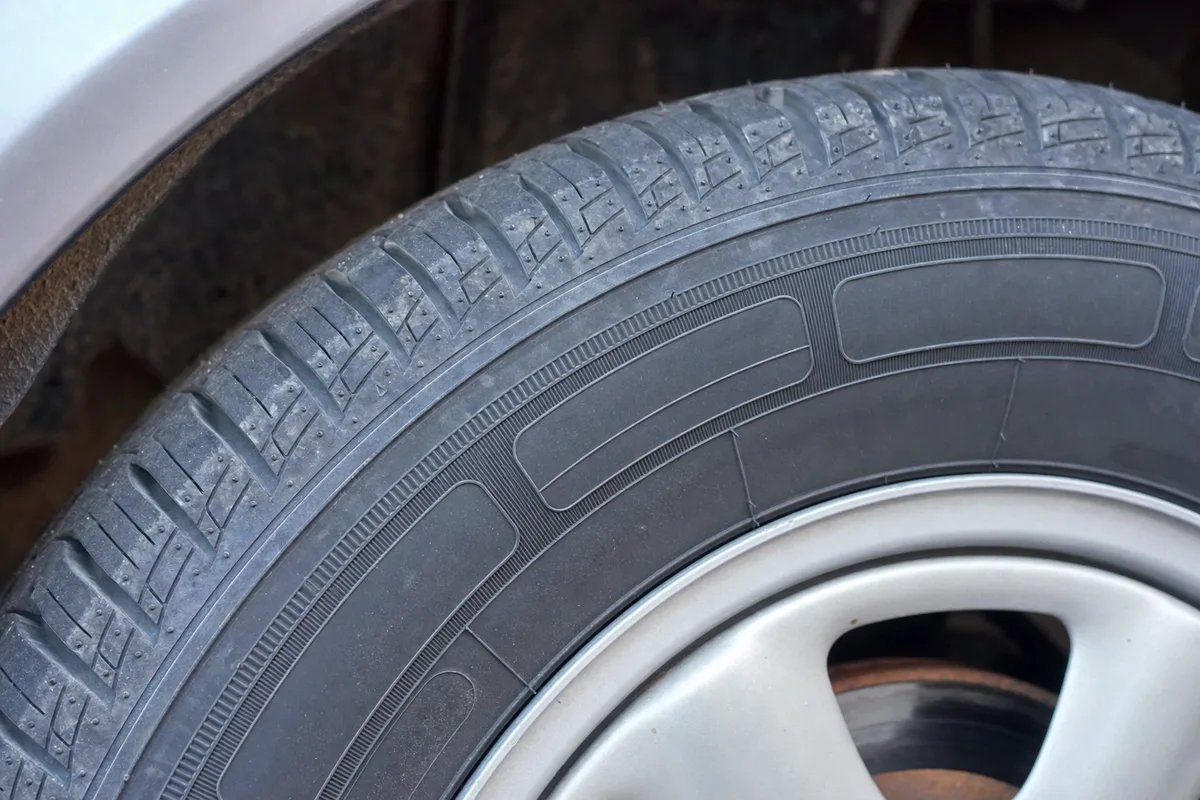
Speed rating table
The rating is the maximum speed the tire can sustain under its rated load, established in a laboratory test where speed is raised in steps until the tire fails. It is a heat-capacity rating that also correlates with sidewall stiffness.
| Letter | Max speed | km/h | Typical use |
|---|---|---|---|
| L | 75 mph | 120 km/h | Off-road and light truck tires |
| M | 81 mph | 130 km/h | Temporary spares |
| N | 87 mph | 140 km/h | Temporary spares |
| P | 93 mph | 150 km/h | Some trailer and LT tires |
| Q | 99 mph | 160 km/h | Winter tires, studded and studless; many LT and all-terrain |
| R | 106 mph | 170 km/h | LT and heavy-duty truck tires |
| S | 112 mph | 180 km/h | Family sedans, minivans, touring all-seasons |
| T | 118 mph | 190 km/h | Family sedans, minivans, winter tires |
| U | 124 mph | 200 km/h | Rare |
| H | 130 mph | 210 km/h | Sport sedans, coupes, many crossovers |
| V | 149 mph | 240 km/h | Sport sedans, performance cars |
| W | 168 mph | 270 km/h | High-performance and exotic cars |
| Y | 186 mph | 300 km/h | Supercars |
| (Y) | Over 186 mph | Over 300 km/h | Hypercars; the rating in parentheses means above 186 mph |
| ZR | Over 149 mph | Over 240 km/h | Older designation, now paired with W or Y |
The order is alphabetical except for H, which sits between U and V for historical reasons.
| Speed rating | Maximum sustained speed |
|---|---|
| T rated | 118 mph |
| H rated | 130 mph |
| V rated | 149 mph |
| W rated | 168 mph |
| Y rated | 186 mph |
The figure is the speed the tire was tested to sustain, not a recommendation. Replacements must meet or exceed the rating on your door placard.
Load index table
The load index is a code from a standard table published by the Tire and Rim Association. Passenger tires typically fall between 82 and 105; light-truck tires between 100 and 130. The figure is the maximum load per tire at the sidewall maximum pressure; kilogram values are in the standard tables and are simply pounds divided by 2.2.
| Index | lbs | Index | lbs | Index | lbs |
|---|---|---|---|---|---|
| 70 | 739 | 89 | 1,279 | 108 | 2,205 |
| 71 | 761 | 90 | 1,323 | 109 | 2,271 |
| 72 | 783 | 91 | 1,356 | 110 | 2,337 |
| 73 | 805 | 92 | 1,389 | 111 | 2,403 |
| 74 | 827 | 93 | 1,433 | 112 | 2,469 |
| 75 | 853 | 94 | 1,477 | 113 | 2,535 |
| 76 | 882 | 95 | 1,521 | 114 | 2,601 |
| 77 | 908 | 96 | 1,565 | 115 | 2,679 |
| 78 | 937 | 97 | 1,609 | 116 | 2,756 |
| 79 | 963 | 98 | 1,653 | 117 | 2,833 |
| 80 | 992 | 99 | 1,709 | 118 | 2,910 |
| 81 | 1,019 | 100 | 1,764 | 119 | 2,998 |
| 82 | 1,047 | 101 | 1,819 | 120 | 3,086 |
| 83 | 1,074 | 102 | 1,874 | 121 | 3,197 |
| 84 | 1,102 | 103 | 1,929 | 122 | 3,307 |
| 85 | 1,135 | 104 | 1,984 | 123 | 3,417 |
| 86 | 1,168 | 105 | 2,039 | 124 | 3,527 |
| 87 | 1,202 | 106 | 2,094 | 125 | 3,638 |
| 88 | 1,235 | 107 | 2,150 | 126 | 3,748 |
Multiply the per-tire figure by four for the total the tires can carry, and compare it with the gross vehicle weight rating (GVWR) on the door placard. A 4,500 lb crossover with 100-index tires (1,764 lbs each, 7,056 total) has ample margin; the same tires on a 6,800 lb three-row SUV towing a trailer do not, which is why the placard calls for a higher index or an XL tire.
Reading LT tires: two indexes and a load range
Light-truck tires carry two load indexes, such as LT265/70R17 121/118S. The first (121, 3,197 lbs) applies when the tire is used as a single; the second (118, 2,910 lbs) applies when it is one of a pair on a dual-rear-wheel axle, where the tires sit close together and cool less effectively.
LT tires also carry a load range letter that describes the strength of the casing, historically expressed as ply rating:
| Load range | Ply rating | Max pressure | Typical vehicle |
|---|---|---|---|
| C | 6 | 50 psi | Half-ton trucks, mid-size SUVs, light trailers |
| D | 8 | 65 psi | Half-ton and some three-quarter-ton trucks |
| E | 10 | 80 psi | Three-quarter and one-ton trucks, heavy towing |
| F | 12 | 95 psi | One-ton duallies and commercial vans |
The load range does not by itself state the load; two E-range tires of different sizes carry different weights, so use the load index. An E-range tire only delivers its rated load at 80 psi. See the truck and SUV tire guide for towing math.
Can you go up or down? The rules
- Load index: equal or higher, always. Going lower is unsafe, voids most warranties and is illegal in states that inspect tires against the placard. A higher index is fine; the tire simply has capacity you will not use.
- Speed rating: match or exceed is the manufacturer recommendation. Going down a step is common with winter tires (H or T instead of V) and many all-terrain tires (S or Q on a truck placarded for T). The vehicle must then be driven no faster than the lower rating.
- Mixing ratings: keep the same rating on an axle, and if the car has different ratings front to rear, the lower one sets the limit for the car.
- XL or Extra Load tires reach a higher index at 41 or 42 psi rather than the standard 35 or 36 psi. If your placard calls for XL, a standard-load tire of the same size does not meet it even if the index looks close.
- P-metric on trucks: a P-metric tire's load must be divided by 1.10 when used on a light truck or SUV, per TRA guidelines. A P265/70R17 at 2,469 lbs becomes 2,245 lbs for truck use.
What the rating tells you about ride and handling
Because higher speed ratings require stiffer sidewalls, stronger belts and more heat-resistant compounds, the rating is a rough proxy for how a tire feels:
- S and T: softer sidewalls, quieter, more forgiving ride, longer tread life, less crisp steering. Right for a Camry, Odyssey or Equinox.
- H: the middle ground, where most crossover and sport sedan tires sit. Noticeably sharper turn-in than T with little penalty in comfort.
- V: firmer, more responsive, more road noise, usually shorter tread life. Common as OE on Accords, 3 Series, Mustangs and many EVs.
- W and Y: performance territory; grip and precision come first, comfort and mileage last. Typical treadwear warranties drop to 30,000 to 45,000 miles or none.
Moving from T to H is a cheap way to sharpen a car's steering if the placard allows it. Our size pages, such as 225/45R17, show the service description for every listing.
Where to find the required rating and what happens if you ignore it
The placard in the driver's door jamb and the owner's manual list the original size and usually the service description. Retailers filter by vehicle and only show tires that meet it.
Consequences of ignoring the rules:
- Overloaded tire: excess heat, tread separation and blowout risk, most often on trucks, minivans full of people and luggage, and trailers.
- Underrated speed on a fast car: heat build-up on long, fast interstate runs in summer.
- Warranty: manufacturers exclude failures on tires used outside their ratings, and a shop may refuse to mount a tire that does not meet the placard.
For the full breakdown of the size code the rating is attached to, see how to read a tire size.
Frequently asked questions
What does 91V mean on a tire?
91 is the load index, meaning the tire can carry 1,356 lbs at its maximum pressure, and V is the speed rating, meaning it is tested to sustain 149 mph. Both must match or exceed the figures on your vehicle's door placard.
Can I use H-rated tires instead of V-rated?
Legally, yes, and it is common with winter tires; H is rated to 130 mph and you must drive within that. Manufacturers recommend matching the original rating, and a lower rating usually means a slightly softer sidewall and less precise steering. Never go lower on the load index.
What is the difference between load index and load range?
Load index is a number that maps to an exact per-tire capacity in pounds and applies to all tires. Load range is a letter (C, D, E, F) used on LT tires to describe casing strength and maximum pressure; it does not by itself state a weight. Use the index to compare capacity.
What load index do I need for towing?
Enough that four tires (or the rear pair for a bumper-pull trailer's tongue weight) cover the truck's gross vehicle weight rating with margin, which the placard specifies. Most half-ton trucks call for an index of 113 to 121; three-quarter-ton and one-ton trucks use E-range LT tires with indexes around 121 to 129.
Updated September 2026.